In many facilities, Modbus-enabled meters, drives, and controllers generate operational data that can help organizations monitor energy consumption, equipment status, operating conditions, and alarm events.
None of it needs to be measured twice.
What it can provide is a path between that data and the applications built to use it, such as remote monitoring tools, energy dashboards, maintenance software, and analytics platforms increasingly built around AI.
The challenge isn’t collecting more data. It’s making existing data usable.
Modern applications typically communicate through technologies such as MQTT and OPC UA, which Modbus was never designed to directly support. For cloud connectivity in particular, lightweight protocols like MQTT can provide an efficient way to move selected operational data beyond the control network.
So the data stays where it was generated, inside equipment that’s doing exactly what it was built to do, while the systems that could use it can’t reach it.
Why Modbus Isn’t the Problem
Modbus has been reliably moving information between industrial devices for decades, and it still does that job well. The challenge is that modern applications expect data to arrive differently:
- A cloud analytics platform wants meaningful point names rather than register addresses.
- An enterprise dashboard is built to subscribe to MQTT.
- A remote monitoring platform may run on OPC UA.
- A maintenance platform may need selected equipment data delivered on a defined schedule or event.
Each system may rely on the same operational data. It simply expects it to be delivered differently, but the equipment producing that data was never built with any of those destinations in mind.
What an Industrial IoT Gateway Does
Calling an industrial gateway a protocol converter isn’t wrong, but it undersells the job. Translating one protocol into another is one function among several. A capable gateway also discovers data across field devices, maps raw registers into point names that mean something outside the control room, transforms values into formats modern platforms expect, and routes information to more than one destination at once, all while keeping the connection secure.
Without those capabilities, a facility may have connectivity without usable information. A raw Modbus register tells an engineer with the device manual open exactly what it represents; to anyone else, it’s a number with no context.
However, when renamed as “pump discharge pressure”, that same value tells an operator what to watch, an analytics platform how to trend it, and a maintenance application when to alert on it. Context is most of the value. The number was always there.
The same logic holds across a whole fleet, not just a single register. Once naming conventions are consistent, a variable-frequency drive throwing a fault code and a flow meter reporting an out-of-range value can both surface as the same kind of alert, understood the same way, regardless of which system picks it up next.
Four Questions Before Mapping the First Point
Every successful integration starts long before the first register is mapped. Whether the project involves one machine or an entire facility, engineers typically answer the same architectural questions before deployment begins.
A device might expose hundreds of registers, but not every one belongs outside the control network. Each additional point adds engineering time, bandwidth, and long-term upkeep. A predictive maintenance application might only need runtime hours and vibration data; an energy dashboard might need voltage, current, and demand; a technician in the field might need nothing more than alarms and status. Moving the right data usually beats moving all of it.
2. Where does the data need to go?
The destination shapes how information should be structured. A cloud platform, a SCADA system, a CMMS, a historian, and a business dashboard can each expect different point names, structures, and update frequencies, so sorting that out before mapping begins usually saves rework later.
3. Which communication protocol fits the application?
MQTT is well-suited to cloud and IoT connectivity because it’s both lightweight and designed for efficient publish-and-subscribe messaging. Rather than requiring applications to continually request data, devices or gateways can publish selected information to a broker, where authorized systems can subscribe to what they need.
OPC UA serves a different role, providing standardized interoperability between industrial systems. The right protocol depends on where the data is going and how it will be used. But for cloud connectivity, minimizing bandwidth and software overhead can make MQTT especially useful.
4. Who owns the connection after commissioning?
Someone needs to manage certificates, update configurations, and troubleshoot failures long after the integration is technically finished. Planning for that ownership up front is usually what separates a project that stays reliable from one that quietly breaks months later.
The Challenge of Maintaining Custom Integrations
Custom scripts don’t scale, even when they work.
A one-off script can connect a single device without much trouble. Doing that hundreds of times over, consistently, is a different challenge.
Custom integrations tend to perform well in a demo and get harder to manage in production, with mappings buried inside code, naming conventions that drift between projects, and security practices that vary depending on whoever built the last one. None of that shows up in a pilot. All of it shows up a year in, often once the person who wrote the original script has moved on.
For OEMs and system integrators in particular, repeatability carries as much weight as connectivity does. Every hour spent reverse-engineering a previous integration is an hour not spent deploying the next one.
Why Configuration Matters More than Custom Code
This is where purpose-built gateways earn their keep—not by eliminating custom code for its own sake, but by making integrations easier to deploy, understand, and repeat. Instead of writing scripts from scratch, an engineer can map Modbus points to their destinations visually, check live values before commissioning, diagnose communication issues through built-in tools, and reuse configurations already proven on similar equipment.
That changes what happens the second time around. Add another production line, and the integration already exists. Ship the same equipment package to a new customer, and the mapping is already validated. When a value doesn’t show up where it’s expected, the team can trace exactly how the data is moving instead of untangling code written months or years earlier by someone else.
Security Must Travel with the Data
Making operational data accessible shouldn’t make it more vulnerable. Once information leaves the control network, it can leverage the same protection as any other connected system: encrypted channels, role-based access, and credentials that are managed rather than shared informally.
The FieldServer Modbus IoT Gateway, for instance, supports certificate-based authentication for connections to platforms like AWS, Azure, and Ignition, along with integrated certificate management that handles CSR and key pair generation, secure credential storage, and expiration notifications, so trust doesn’t depend on someone remembering to renew something manually. These aren’t add-ons. These controls help operations, IT, and cybersecurity teams confidently approve the connection.
Connecting Modbus Data to Modern IIoT Platforms
The FieldServer Modbus IoT Gateway was built around a broader view of industrial connectivity, not just protocol translation. It bridges the gap between Modbus devices and the modern applications that depend on their data by discovering information across field devices, mapping registers into meaningful point names, and delivering that information through MQTT or OPC UA, with support for RESTful APIs and webhooks when an application requires them. For organizations using MSA Grid, the gateway can also publish up to 1,000 Modbus values to provide a cloud-based view alongside on-site operations.
For cloud-connected applications, MQTT provides a lightweight way to publish selected device data without placing unnecessary demands on the surrounding software architecture.
Purpose-built tools help simplify deployment and long-term management. Visual point mapping, live diagnostics, and reusable configurations reduce engineering time while helping make integrations easier to troubleshoot and repeat. Built-in security features, including TLS encryption, certificate management, and audit logging, help protect operational data throughout its lifecycle.
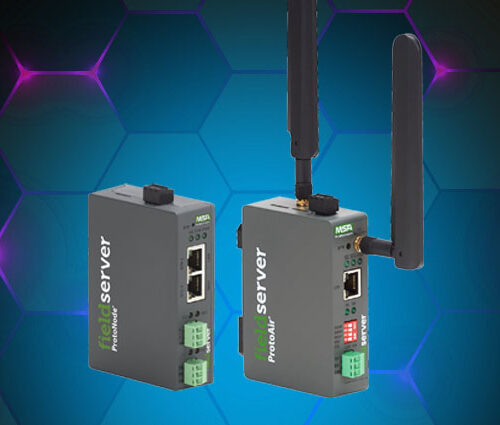
The gateway is also available in multiple hardware configurations, including serial-only models, dual Ethernet versions, and cellular or Wi-Fi options, allowing organizations to match the gateway to existing infrastructure rather than redesigning a network around a single deployment.
That combination of connectivity, configuration, and deployment flexibility helps organizations scale beyond a single proof of concept. The same architecture that connects one production line can be reused across additional facilities, OEM equipment packages, or customer installations with far less engineering effort.
None of it requires replacing equipment that’s already doing its job. The value has been there all along, inside the meters, drives, and controllers running the facility. The FieldServer Modbus IoT Gateway helps make that operational data accessible, understandable, and secure so organizations may benefit from the systems they already own.
Looking to connect Modbus data to modern IIoT applications? Contact us to learn how the FieldServer Modbus IoT Gateway can help simplify secure, repeatable industrial data integration.

Recommended for You